Major projects rarely become expensive because of one dramatic mistake. More often, cost begins with something nobody noticed early enough.
A project can survive a difficult contractor.
It can survive a delayed shipment.
It can survive a difficult approval.
What is much harder to survive is a problem that nobody realizes exists.
Because by the time everyone can see it, it may already be expensive.
A misunderstanding becomes a revision.
A revision becomes a delay.
A delay creates pressure.
Pressure creates compromises.
And eventually, something that began as a small gap in understanding becomes a very real line on the budget.
This is one of the least visible risks in complex development:
The risk of not seeing the problem early enough.
What You Can't See, You Can't Challenge
Think about a major development before construction begins.
Hundreds of drawings.
Dozens of disciplines.
Different consultants.
Different priorities.
Multiple stakeholders.
And countless decisions moving simultaneously.
Everyone has information.
But information is not the same as visibility.
A project team can possess thousands of pages of documentation and still struggle to answer one deceptively simple question:
“What happens when all of this comes together?”
That question is where complexity becomes risk.
The Earlier a Problem Becomes Visible, the Cheaper It Is to Discuss
This is not an argument against digital tools.
Quite the opposite.
Modern visualization has transformed how complex projects are designed and communicated.
3D environments can reveal details that were almost impossible to communicate two decades ago.
Interactive systems can allow stakeholders to explore scenarios.
VR can create immersive experiences.
AI can accelerate analysis.
But every tool solves a different part of the problem.
The deeper challenge remains:
Can everyone in the room understand the same system at the same time?
Because when they can, disagreement becomes productive.
When they can't, disagreement becomes expensive.
A Scale Model Does Something Screens Often Don't
It gives complexity a place to gather.
Put a large-scale development on a screen and people often experience it sequentially.
One view.
Then another.
Then another.
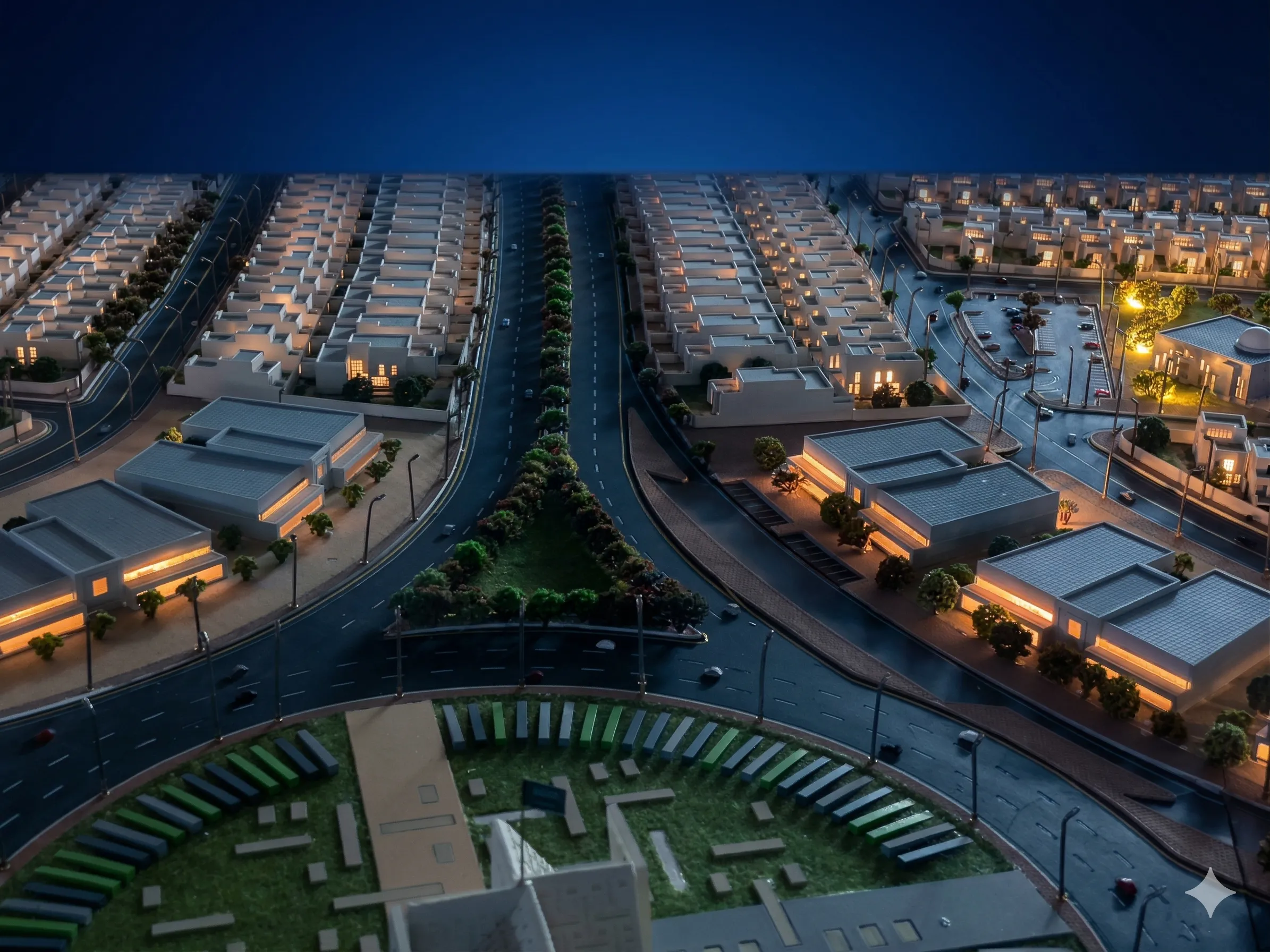
A physical model changes that relationship.
The entire system exists in front of everyone simultaneously.
People can move around it.
Compare zones.
Trace connections.
Point to relationships.
Notice what wasn't obvious from a single perspective.
And suddenly, a conversation that was previously abstract becomes physical.
Not simpler.
More discussable.
That distinction matters.
Because the purpose of visualization isn't to eliminate complexity.
It's to make complexity manageable enough to question.
Consider What Happens Around a Model
A good model doesn't make everyone agree.
That would actually be a bad sign.
Instead, it makes disagreement more specific.
“Why is this connection here?”
“What happens to this area?”
“Why is this building positioned this way?”
“How does this relate to the surrounding development?”
These are better questions than:
“I don't really understand the proposal.”
And better questions lead to better decisions.
The model's value, therefore, isn't only in what it shows.
It's in what it reveals people didn't know they needed to ask.
The Real Competitive Advantage Is Not Visualization
It's timing.
A problem discovered during a strategic discussion is a conversation.
The same problem discovered after construction begins is an intervention.
The same problem discovered after completion is a legacy.
This is why the best project presentations are not simply beautiful.
They are deliberately designed to expose relationships, assumptions, scale, and consequences while there is still time to act.
Visibility has a window of value.
The earlier you create it, the more useful it becomes.
This Changes What an Architectural Model Really Is
For years, the architectural model was associated with presentation.
Something placed in a showroom.
Something photographed at a launch.
Something built to impress.
That definition is no longer enough.
For complex projects, a high-precision model can become part of the decision environment itself.
It can support:
Stakeholder alignment.
Strategic communication.
Project visualization.
Executive decision-making.
Public presentation.
And when integrated with digital and interactive technologies, it can become part of a broader visualization ecosystem rather than a standalone object.
That is a very different proposition.
The model is no longer simply showing the project.
It is helping the project reveal itself.
City Scale: Making the Invisible Discussable
Since 1998, City Scale has worked at the intersection of architecture, engineering, visualization, and physical representation.
Today, the company reports more than 3,000 completed models across more than 30 countries, supported by a team of 200 technicians and engineers. Its capabilities extend beyond architectural and engineering models into VR, 3D animation, interactive solutions, and Smart Model AI.
Its portfolio spans residential and commercial developments, industrial facilities, infrastructure, healthcare, education, cultural projects, ports, airports, and urban-scale developments.
That range matters because the harder a project becomes to explain, the more important the method of explanation becomes.
A model should not merely reproduce what the architect already knows.
It should help everyone else see what they need to know.
The Cost of Seeing Too Late
The most expensive problem in a project isn't always the one with the biggest price tag.
Sometimes it is the one that remained invisible long enough to become one.
That is why the future of project visualization isn't about making projects look more impressive.
It is about making complexity visible while decisions can still change the outcome.
Because once construction begins, some questions become expensive.
Before construction begins, they can still be valuable.
The earlier a project can see its own complexity, the greater its chance of controlling it.
City Scale Insight
Don't wait for a project problem to become visible on site.
Make it visible while it can still be solved.